 Ngày đăng: 23/08/2026
At noon on August 22, the Heart Institute - Bach Mai Hospital successfully performed a thoracic endovascular aortic repair (TEVAR) procedure for a 63-year-old male patient with a descending thoracic aortic aneurysm measuring up to 89mm. This case presented challenges not only regarding the size of the aneurysm but also concerning complex calcified and tortuous anatomical morphology.
Challenging case
A 63-year-old male patient was admitted in critical condition due to a descending thoracic aortic aneurysm. Diagnostic imaging results showed that the aneurysm had a maximum diameter of up to 89mm—an alarming figure, posing a latent risk of aortic rupture and sudden death at any time.
Assoc. Prof. Dr. Pham Minh Tuan, who directly performed the intervention, stated: "An 89mm aneurysm is like a 'ballooning sphere' in the chest cavity, subjected to extremely high blood flow pressure. However, the greatest challenge lies not only in the size but also in the anatomical morphology: the aortic segment was calcified, tortuous, and severely angulated. To navigate large catheter systems through these tortuous segments without tearing the vessel wall or dislodging atherosclerotic plaques, as well as to deploy the stent graft with millimetric precision at the target site, requires absolute accuracy in the team's maneuvers."
According to Dr. Minh Tuan, calculating the stent graft in endovascular intervention demands rigorous precision akin to "custom tailoring" for each vascular segment. The team must select a stent graft diameter 10-20% larger than the healthy vessel size to create maximum radial force, preventing endoleak into the aneurysm sac. Concurrently, determining the safe "landing zone" must be impeccably precise to ensure the stent anchors firmly without covering or injuring critical arterial branches.
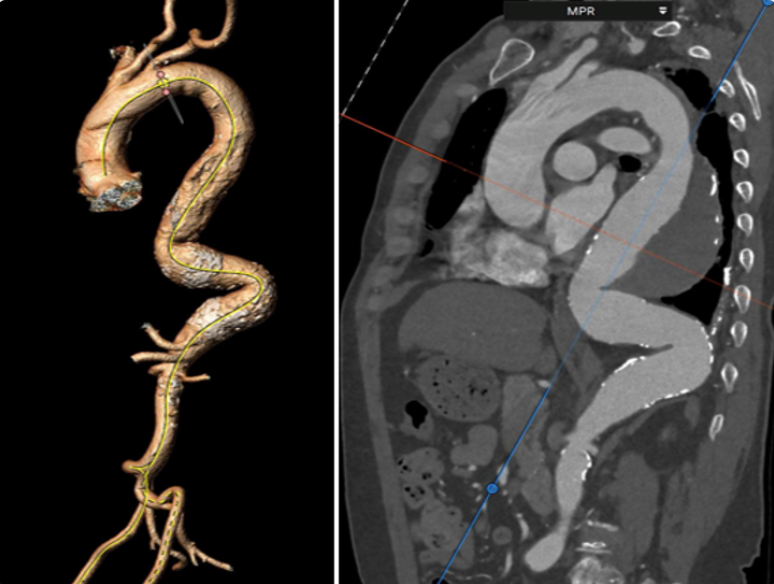
Image of a large thoracic aortic aneurysm with rupture risk, calcification, tortuosity, and angulation
The Power of the "Heart Team" Model
Facing a critical case, the decision of the Heart Team (multidisciplinary consultation team) plays a vital role.
Master, Resident Doctor Tran Ngoc Cam shared: “During the consultation, we conducted a comprehensive analysis. Traditional open surgery carries an extremely high risk of mortality due to the patient's age and physical condition, whereas endovascular intervention—despite extremely challenging anatomy—is the optimal option. Open surgery requires a sternotomy combined with a long incision, cardiopulmonary bypass, and a prolonged recovery time. Meanwhile, choosing the thoracic endovascular aortic repair (TEVAR) method only requires access through a small vascular exposure in the groin area. This is a minimally invasive method that helps reduce pain, limit blood loss and infection, and allows the patient to recover their physical condition rapidly.”
The interventional team of the Vietnam National Heart Institute, Bach Mai Hospital, included Assoc. Prof. Dr. Pham Minh Tuan, Master, Resident Doctor Tran Ngoc Cam, and Master, Resident Doctor Le Ngoc Thien. With seamless and precise coordination in every technical step, the team successfully placed the stent graft, completely eliminating the aneurysm and ensuring the patient's safety.


The interventional team performing the stent graft placement for a patient with a complex massive thoracic aortic aneurysm.
Evaluating the professional significance of the case, Assoc. Prof. Dr. Nguyen Thi Thu Hoai, Director of the Vietnam National Heart Institute, Bach Mai Hospital, affirmed: "The success of this intervention is not merely the resolution of a massive aneurysm, but a testament to the seamless coordination of the 'Heart Team' model at the Heart Institute. Choosing endovascular intervention instead of traditional open surgery in the context of complex anatomy requires thorough preparation of imaging, decisiveness in the interventional strategy, and the team's ability to handle arising situations. This is our priority orientation: continuously applying minimally invasive techniques to bring the best benefits, reduce trauma, and shorten recovery time for patients."
Recommendations from experts at the Vietnam National Heart Institute
The success of the case further affirms the professional capacity of the Vietnam National Heart Institute, Bach Mai Hospital, in mastering complex cardiovascular and structural heart intervention techniques. This is the result of multidisciplinary coordination among cardiovascular intervention, cardiovascular surgery, anesthesiology and resuscitation, and diagnostic imaging according to international standards.
Doctors also issue a warning: Aortic aneurysms are considered a "silent killer" because the disease progresses silently, with almost no clear symptoms until a crack or rupture occurs—a time when the mortality rate reaches 80-90%.
The public, especially individuals over 50 years old with a history of hypertension, smoking, or persistent chest tightness or back pain, should proactively undergo regular check-ups. Detecting the disease at an early stage through ultrasound or computed tomography (CT scan) will make the treatment strategy much more proactive, safe, and effective./.
Dieu Hien



78 Giai Phong Street, Kim Lien Ward, Hanoi City
1900.888.866
096.985.1616
Department of Examination on Demand:
Department of Examination: Monday - Friday
National Route 21B, Liem Tuyen Ward, Ninh Binh Province
1900.888.866
0969851616
Outpatient Department on Demand (On-demand Clinic)
+ Monday - Friday:
+ Saturday - Sunday:
Outpatient Department (Standard Clinic): Monday - Friday
+ Working hours:
Main responsible person: Associate Professor, Dr. Dao Xuan Co - Hospital Director




