 Ngày đăng: 29/09/2026
Chronic liver disease often progresses silently over many years. By the time clear symptoms appear, many patients have already reached advanced cirrhosis or liver cancer. At the scientific symposium "From Fibrosis to Liver Cancer" co-organized by Bach Mai Hospital, Dr. Dao Huyen Quyen, Vice Director of the Institute of Laboratory Medicine and Head of the Department of Biochemistry, shared a new approach: applying digital algorithms to synthesize laboratory data, assisting clinicians in risk stratification and in identifying patients who require specialized monitoring and in-depth diagnosis.
Silently Progressing Lesions
At specialized hepatobiliary medical examination and treatment facilities, numerous cases of liver cancer are detected during routine health checkups or while testing for another medical condition. Chronic liver disease typically causes no obvious symptoms in its early stages, leading patients to easily overlook regular monitoring and follow-up examinations.
Alongside well-known causes such as hepatitis B and hepatitis C, metabolic dysfunction-associated steatotic liver disease is receiving increasing attention, particularly among individuals who are overweight, obese, or have diabetes.

In monitoring liver disease, ultrasound and AFP tests are commonly used methods. However, each method has certain limitations. The quality of ultrasound can depend on various factors, including patient characteristics and the operator's experience. Meanwhile, relying solely on a single biomarker like AFP results in limited capability for detecting early-stage liver cancer.
According to experts, the challenge is how to identify high-risk patients even when lesions are still small, while appropriately utilizing imaging and laboratory diagnostic tools to avoid unnecessary orders.
This is also one of the approaches that experts at Bach Mai Hospital are focusing on.
Combining multiple data points, instead of evaluating each individual index
Sharing at the symposium, Dr. Dao Huyen Quyen stated that modern medicine is increasingly emphasizing the combination of multiple patient data points rather than assessing each laboratory index individually.
Accordingly, information such as age, sex, liver enzymes, platelet count, and other biomarkers can be incorporated into clinical algorithms to assist in risk stratification.
One example is FIB-4, an algorithm that uses age, liver enzyme levels, and platelet count to aid in assessing the risk of liver fibrosis. This tool can help physicians initially stratify patients into a low-risk group, thereby considering appropriate in-depth evaluation methods.
Another approach is ADAPT, which uses information regarding the PRO-C3 biomarker in combination with clinical data to support the assessment of liver fibrosis severity.
Notably, at the symposium, experts mentioned the GAAD algorithm, which combines two biomarkers, AFP and PIVKA-II, with age and sex to assist in evaluating the risk of hepatocellular carcinoma.
According to Dr. Dao Huyen Quyen, combining multiple data points can provide physicians with additional reference information during patient evaluation, especially when used alongside appropriate monitoring and diagnostic imaging methods.
Experts also emphasized that algorithms do not replace doctors or in-depth diagnostic methods, but rather serve as a supportive tool to help identify risk groups for appropriate follow-up strategies and subsequent diagnostic orders.
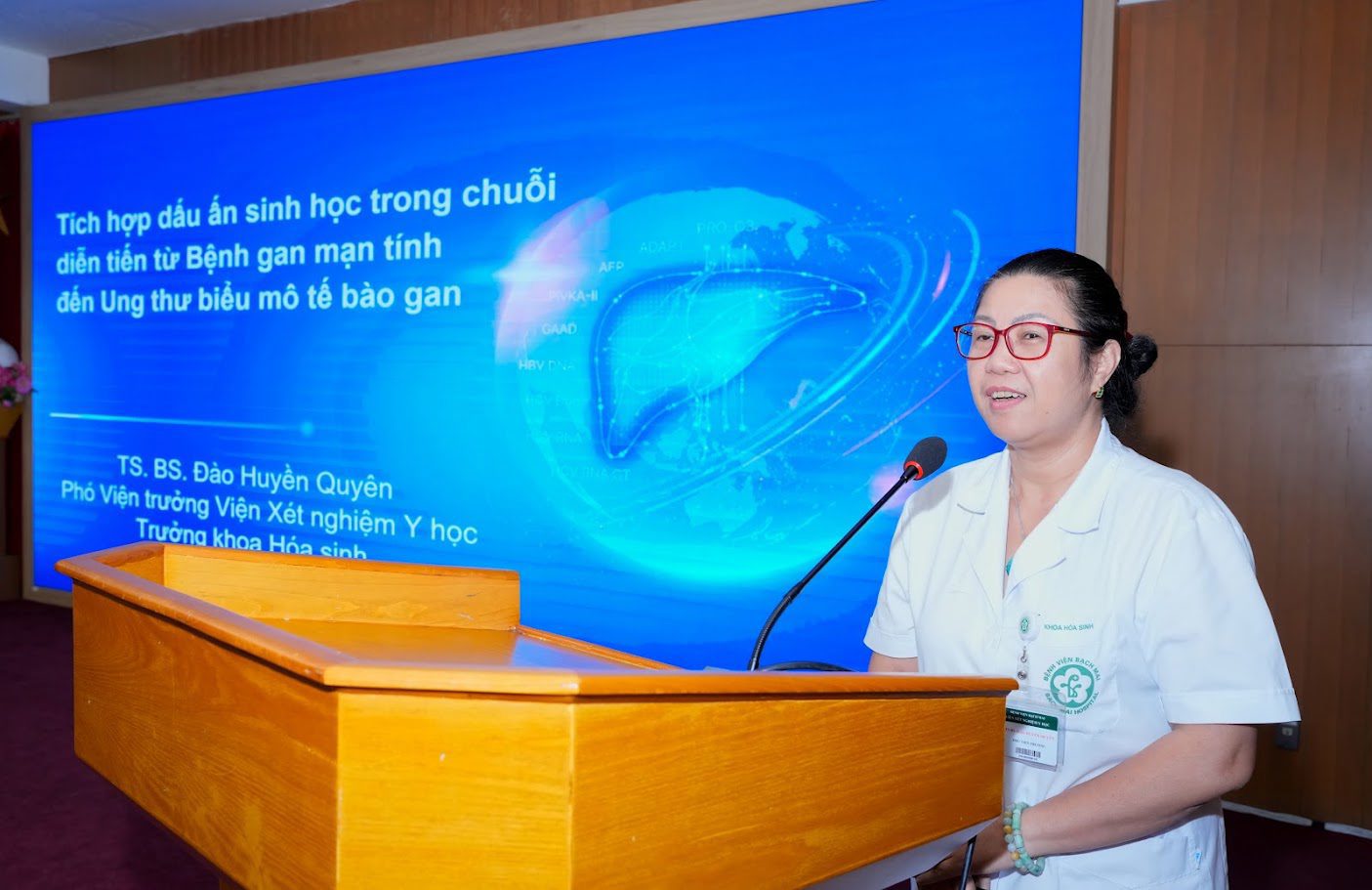
Dr. Dao Huyen Quyen presented at the scientific symposium
From the laboratory to electronic medical records
To put digital solutions into practice, the Department of Biochemistry at Bach Mai Hospital is proposing the implementation of navify software, connecting with the hospital's LIS/HIS system.
Under this approach, instead of manually calculating each index, laboratory data after being system-analyzed will be automatically synthesized by the software according to established algorithms. Risk stratification results can be returned to the electronic medical record system, providing clinicians with additional reference information right during the consultation and treatment process.
The digitization process, once implemented, will create connectivity across all stages—from test ordering and specimen analysis to data synthesis and result reporting. As a result, doctors can reduce manual data processing time while mitigating the risk of calculation errors.
Particularly, data interoperability among specialties such as Laboratory Medicine, Gastroenterology, Endocrinology, and Diagnostic Imaging can support a more comprehensive evaluation of patients.
Dr. Dao Huyen Quyen noted that applying digital algorithms aims not merely to automate a single laboratory procedure, but rather to transform the role of laboratory medicine within the patient care continuum.
Moving from providing isolated lab results, the laboratory system can gradually become an analyzed and integrated data source, delivering additional valuable insights to clinicians during decision-making.
This is also the development direction emphasized by the Institute of Laboratory Medicine at Bach Mai Hospital during digital transformation, aiming to integrate laboratory expertise, clinical data, and modern analytical tools.
In the context of growing concern over chronic liver disease, early detection of fibrosis and liver cancer risks holds crucial significance for monitoring and treatment. The integration of laboratory data, supportive algorithms, and clinical evaluation is expected to provide physicians with an enhanced tool to recognize risks, select appropriate examination methods, and make timely decisions for patients.
Dieu Hien - The Anh



78 Giai Phong Street, Kim Lien Ward, Hanoi City
1900.888.866
096.985.1616
Department of Examination on Demand:
Department of Examination: Monday - Friday
National Route 21B, Liem Tuyen Ward, Ninh Binh Province
1900.888.866
0969851616
Outpatient Department on Demand (On-demand Clinic)
+ Monday - Friday:
+ Saturday - Sunday:
Outpatient Department (Standard Clinic): Monday - Friday
+ Working hours:
Main responsible person: Associate Professor, Dr. Dao Xuan Co - Hospital Director




