 Ngày đăng: 13/03/2026Tác giả: Hien Dieu
In the rush of modern life, the line between life and death can sometimes be as fragile as a single breath. If someone suddenly collapses from cardiac arrest on a busy street, what could bring them back to life?
The answer lies not only in modern medical equipment, but also in well-trained hands and a strategic vision that brings life-saving emergency skills closer to the community.
Flowers blooming in everyday life
In early March 2026, the Minister of Ministry of Health of Vietnam decided to award Certificates of Merit to nurse Pham Thi Thuy Ha and physician Dinh Thi Quynh Huong of Bach Mai Hospital for their timely action in saving a person’s life during a community emergency.
This recognition was not only for two outstanding individuals. It also reaffirmed that Bach Mai’s medical professionals do not shine solely in emergency rooms-they are also ready to act in everyday situations when every minute can determine whether a life is saved.
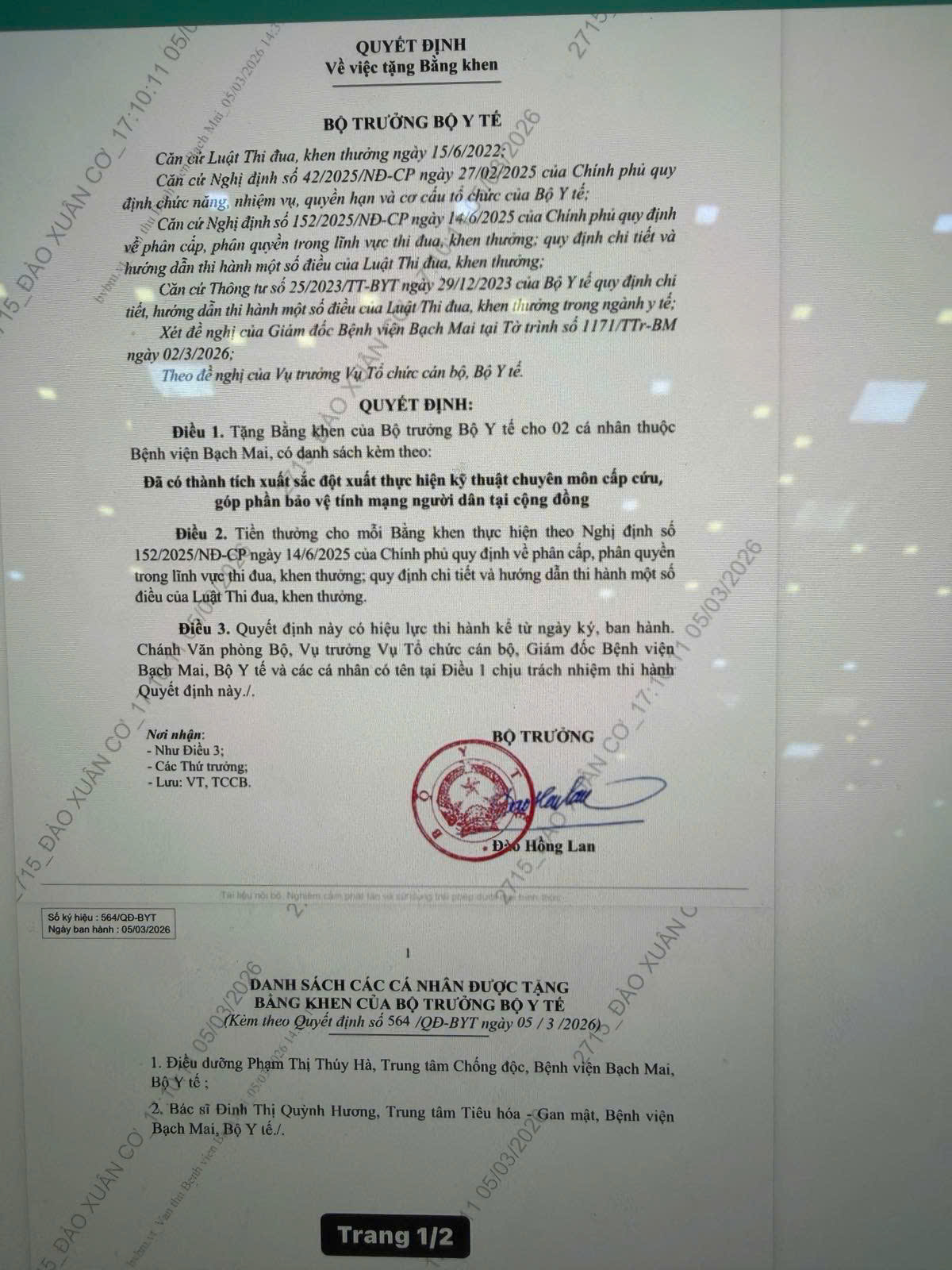
Saving someone who suffers cardiac arrest outside a hospital is not merely an instinctive reaction. It is the result of rigorous training, professional expertise, and a deep sense of responsibility among healthcare professionals.
The message that the healthcare sector-and Bach Mai Hospital in particular-wants to convey is clear: healthcare must always stand ready to protect people’s lives, wherever they may be.
From individual highlights to a strategic flame
However, a few outstanding individuals alone cannot safeguard millions of lives.
Recognizing this, the leadership of Bach Mai Hospital has pursued a broader goal: making life-saving emergency skills a common capability at the grassroots healthcare level.
A clear example is the letter of appreciation sent by the People's Committee of Cua Nam Ward to the hospital following an emergency response training program for local healthcare staff.
Over three days (March 11–13, 2026), more than 100 grassroots healthcare workers received direct, hands-on training from the hospital’s leading specialists in cardiopulmonary resuscitation for cardiac arrest and the management of anaphylaxis.
In the letter, local authorities shared: “The dedicated support from Bach Mai’s experts has not only strengthened professional capacity but also demonstrated the spirit of partnership between central-level hospitals and grassroots healthcare.”
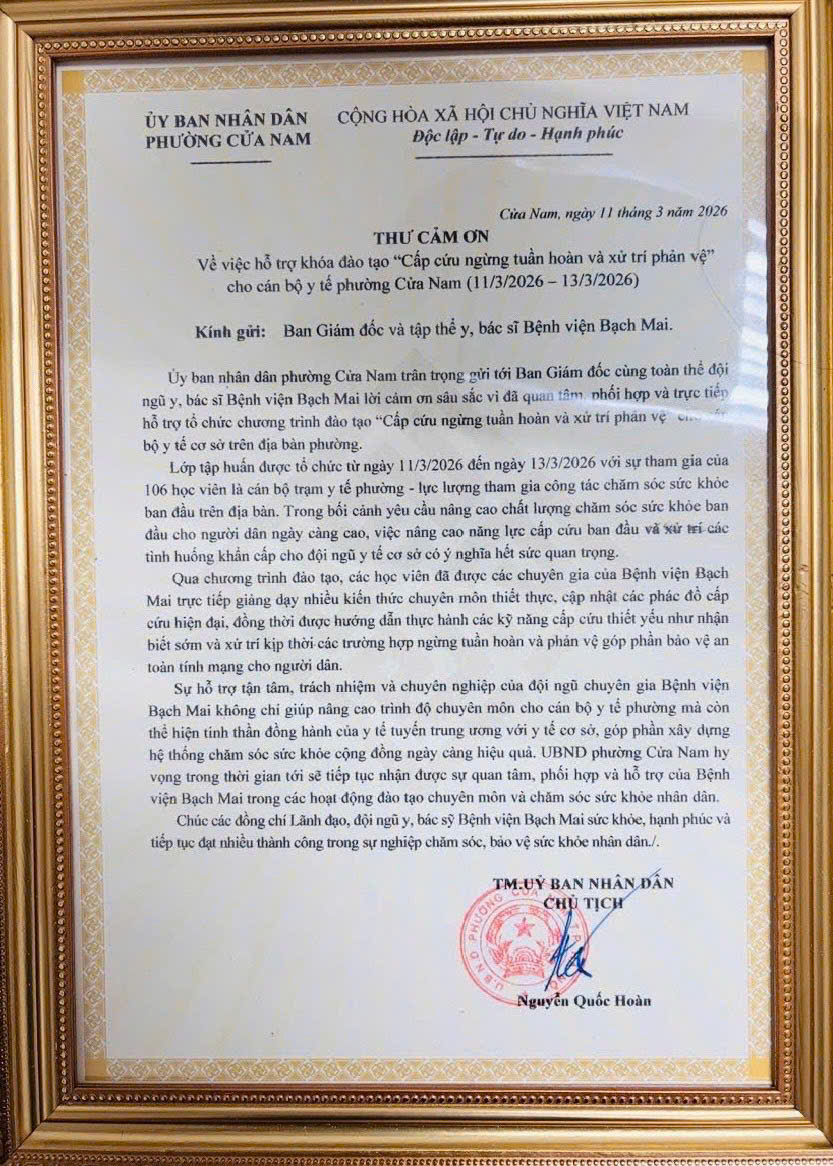
When ward and commune healthcare providers are equipped with standardized knowledge and practical skills, the ultimate beneficiaries are the people themselves.
A “safety network” for every heartbeat
In cardiovascular emergencies, physicians often refer to the concept of the “golden time.” A patient in cardiac arrest has only the first few minutes for effective intervention.
Even the most skilled doctors at central hospitals may struggle to save a patient if proper first aid is not provided within those critical minutes at the community level.
For this reason, training emergency response skills for grassroots healthcare workers is more than a professional activity. It is about building a “network that protects life” right from the frontline.
This approach also reflects a shift in healthcare management thinking: hospitals are not merely treatment facilities, but centers for knowledge dissemination—supporting and strengthening the capacity of lower-level healthcare systems.
Conclusion
Certificates of merit or letters of appreciation may appear modest, yet they represent important pieces in the broader vision for the development of Bach Mai Hospital.
That vision is measured not only by the number of hospital beds or modern medical devices, but by how many heartbeats are preserved and how many families remain whole thanks to life-saving skills shared with the community.
When medical ethics are combined with sound strategy and timely recognition from society, the power to protect life is multiplied—not only within hospital walls, but wherever someone may need help.



78 Giai Phong Street, Kim Lien Ward, Hanoi City
1900.888.866
096.985.1616
Department of On-Demand Medical Examination:
Outpatient Department: Monday – Friday
Main responsible person: Associate Professor, Dr. Dao Xuan Co - Hospital Director




