 Ngày đăng: 13/08/2026
Continuously receiving severe malaria cases returning from Africa, Bach Mai Hospital not only effectively treats them but also shares its supply of Artesunate with the Ho Chi Minh City Hospital for Tropical Diseases. Traversing over 1,700 km right through the night, the medication arrived in time, contributing to saving the life of a severe malaria patient.
Continuously effectively treating severe malaria cases
Following two severe malaria cases successfully treated in late June and early July, in recent days, the National Institute of Tropical Medicine, Bach Mai Hospital, continued to admit cases of malaria who had lived and worked in Africa—a region where malaria remains strongly endemic. Among them, there were severe cases caused by P. falciparum, the most dangerous malaria-causing parasite in humans.
Notably, a 32-year-old male patient from Thanh Hoa, who had worked in Angola from July 2024 to July 2025. After returning to Viet Nam, the patient worked in Ha Tinh and recently moved to Cat Hai island, Hai Phong. The patient had not traveled abroad recently.
Starting from August 5, the patient developed high fever, chills, and fatigue, experiencing 2 to 3 fever episodes per day. As the condition worsened, the patient had to visit multiple medical facilities.
In Hai Phong, test results and malaria parasite smear examinations detected P. falciparum in large quantities. Alarmingly, the patient experienced hypotension and a severe drop in platelets, and was diagnosed with malaria caused by P. falciparum and septic shock. Due to the lack of specific treatment medication, the patient was promptly transferred to Bach Mai Hospital.
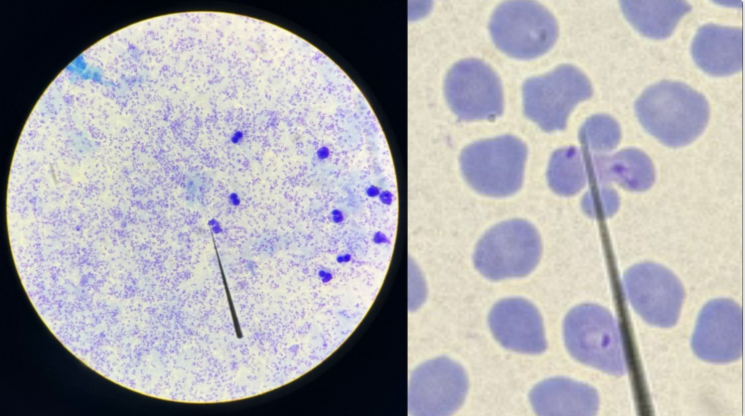
Specimen of malaria parasite P. falciparum from the patient on a glass slide
At the time of admission to the National Institute of Tropical Medicine, Bach Mai Hospital, the density of malaria parasites in the blood was very high. The patient was diagnosed with severe malaria caused by P. falciparum accompanied by renal failure and liver failure, requiring urgent resuscitation and specific treatment.
By August 11, the patient's fever had subsided, consciousness was alert, and clinical condition had clearly improved.
Previously, the National Institute of Tropical Medicine also treated a 23-year-old female patient from Nghe An, who had lived and worked in Nigeria.
Six days before admission, the patient had sought medical examination in Africa for a high fever of 38.8-39 degrees Celsius, chills, and sweating, and was diagnosed with P. falciparum malaria but received incomplete treatment.
On August 1, after returning to Viet Nam and seeking examination at the National Institute of Tropical Medicine with manifestations of increased fatigue, bilateral lower extremity edema, and dark red urine, the patient was indicated for hospital admission. Following a process of monitoring and treatment, the patient recovered, her health stabilized, and she was discharged from the hospital.
These cases once again demonstrate that although malaria is no longer common in many localities of Viet Nam, imported cases in individuals who have previously lived in malaria-endemic regions can still appear and progress rapidly and severely if not diagnosed early.
According to a report by a World Health Organization representative, there are currently over a dozen indigenous malaria cases in Viet Nam each year. However, there are more than 100 imported malaria cases due to patients having lived and worked in malaria-endemic countries, primarily in Africa.
Traversing over 1,700 km through the night for the medication to reach the patient
Not only treating patients at Bach Mai, in recent days, the Hospital's physicians have also participated in a special race against time covering a distance of over 1,700 km.
The Hospital for Tropical Diseases in Ho Chi Minh City admitted a severe malaria case requiring urgent use of Artesunate. However, the medicine supply in the southern region at that time was depleted.
With severe malaria, specific medication is not merely a treatment choice. The timing of administration can determine the clinical course and survival chances of the patient. Through connections among medical facilities, Bach Mai Hospital is one of the few units that still has a supply of the medication.
Immediately upon receiving the information, Bach Mai Hospital urgently completed procedures to share Artesunate from a batch of medication recently donated by the World Health Organization (WHO).
From Ha Noi, the medication was transported into Ho Chi Minh City right through the night, traversing a distance of over 1,700 km to reach the patient in time.
After accessing the specific medication, combined with active treatment and close monitoring, the patient's health in Ho Chi Minh City has now recovered well, and their condition is stable.
Do not overlook the patient's residential history
According to Dr. Do Van Thanh, Deputy Director of the National Institute of Tropical Medicine, Bach Mai Hospital, from recent cases, the epidemiological factor that needs special attention when approaching patients with fever of unknown origin is their history of residence and work.
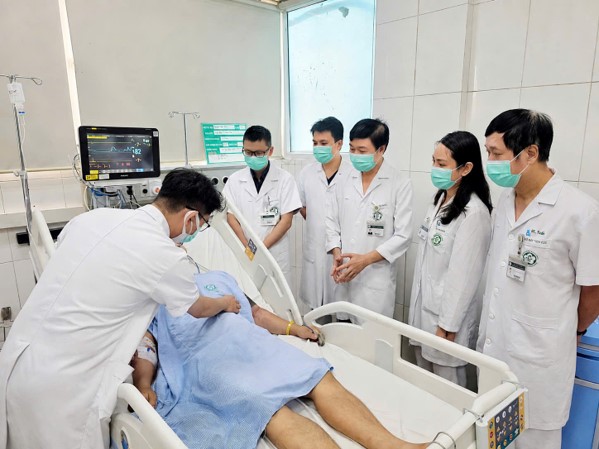
Dr. Do Van Thanh, Deputy Director, along with doctors from the National Institute of Tropical Medicine, Bach Mai Hospital, examines a patient
In clinical practice, one should not simply ask patients whether they "have traveled abroad recently," but rather thoroughly explore whether they have ever lived, worked, or returned from Africa or malaria-endemic regions.
The case of the 32-year-old male patient is an example. Although he left Angola for over a year and has not traveled abroad recently, his history of having lived in a malaria-endemic region remains a valuable piece of data to guide diagnosis.
For individuals who have lived or worked in Africa and malaria-endemic regions, when symptoms such as fever, chills, sweating, severe fatigue, or abnormal manifestations appear, they should proactively inform physicians of their epidemiological history and visit a medical facility early.
Patients should also not self-treat or arbitrarily stop medication as soon as the fever subsides. Malaria must be accurately diagnosed, treated according to the correct regimen, and fully monitored.
The successive cases at Bach Mai, along with the journey of transporting Artesunate over 1,700 km through the night, reiterate a reality: malaria may have become unfamiliar to many people in Viet Nam, but it has by no means disappeared.
In the battle against severe malaria, sometimes the chance of survival stems from asking the right question about where the patient has lived, diagnosing early enough, and delivering the correct medication to the patient—even if the distance is over 1,700 km or further.
Nguyen Ha



78 Giai Phong Street, Kim Lien Ward, Hanoi City
1900.888.866
096.985.1616
Department of Examination on Demand:
Department of Examination: Monday - Friday
National Route 21B, Liem Tuyen Ward, Ninh Binh Province
1900.888.866
0969851616
Outpatient Department on Demand (On-demand Clinic)
+ Monday - Friday:
+ Saturday - Sunday:
Outpatient Department (Standard Clinic): Monday - Friday
+ Working hours:
Main responsible person: Associate Professor, Dr. Dao Xuan Co - Hospital Director




