 Ngày đăng: 23/07/2026
A 68-year-old patient was admitted presenting with massive hematemesis of bright red blood, decreased blood pressure, and a hemoglobin level of only 57 g/L, facing the risk of hemorrhagic shock due to gastric variceal rupture. In this emergency situation, doctors at the Department of Radiology, Bach Mai Hospital Ninh Binh facility, successfully deployed for the first time the Plug-Assisted Retrograde Transvenous Obliteration (PARTO) technique, managing the variceal cluster, controlling the source of bleeding, and promptly saving the patient's life.
Critical Condition Due to Gastric Variceal Rupture
A 68-year-old patient with a history of cirrhosis and previous treatment for gastrointestinal bleeding was admitted to the Bach Mai Hospital Ninh Binh facility after vomiting a large amount of bright red blood.
Upon admission, the patient was in a state of severe blood loss, with blood pressure dropping to only 91/52 mmHg. Laboratory tests showed that the hemoglobin concentration dropped to 57 g/L, warning of the risk of hemorrhagic shock, circulatory failure, and a direct threat to life if not managed promptly.
Endoscopic results recorded a cluster of gastric varices in the subcardiac region. This is a location difficult to access and difficult to control bleeding by endoscopy, especially when the variceal cluster is large or has a complex vascular system.
Immediately afterward, clinical doctors and the interventional radiology team held an emergency consultation to evaluate the patient's condition, the characteristics of the variceal cluster, and the shunt vessel system. On this basis, the patient was indicated to undergo the PARTO technique.
PARTO (Plug-Assisted Retrograde Transvenous Obliteration) is a retrograde transvenous embolization method supported by a vascular plug device. Instead of open surgery, the doctor passes a small catheter through the venous system to the feeding vessel of the variceal cluster, then deploys the vascular plug device to close the abnormal blood flow and occlude the variceal cluster.
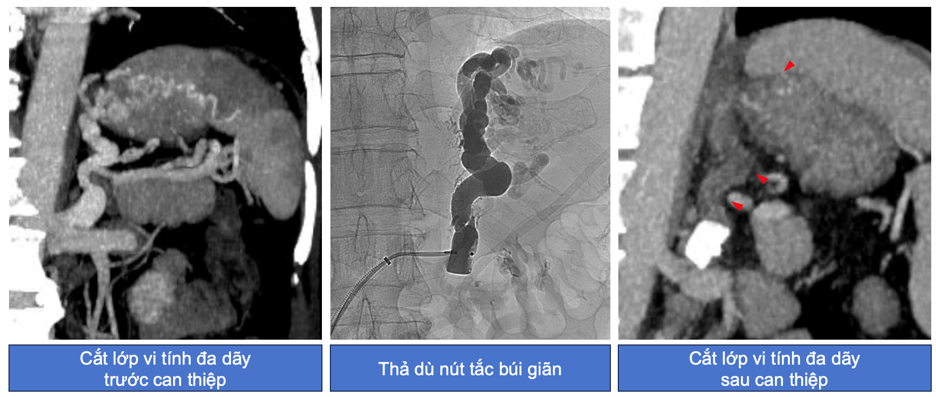
The procedure was performed on a digital subtraction angiography system and completed in about 20 minutes. Post-intervention check images showed that the variceal cluster was occluded as planned, and the source of bleeding was controlled.
Following the procedure, the patient continued to be closely monitored, received blood transfusions, had anemia corrected, and received coordinated treatment for cirrhosis and portal hypertension.
The interventional team consisted of M.D., Resident Doctor Do Dang Tan, M.D., Resident Doctor Nguyen Anh Tuan, Technician Vu Van Trieu, Technician Dang Quang Anh (Department of Radiology), and Doctor Tran Duc Minh (Department of Anesthesiology and Resuscitation).
According to Ph.D., M.D. Nguyen Ngoc Trang, Deputy Director of the Institute of Diagnostic and Interventional Radiology, Bach Mai Hospital, hemorrhage caused by gastric variceal rupture typically progresses very rapidly, and the volume of blood loss can be massive. In some cases, endoscopy is difficult to access or cannot achieve sustainable bleeding control.
"PARTO is a minimally invasive method with a small access route, fast execution time, and effective variceal cluster control capability. The technique is particularly useful in cases where endoscopy is difficult to perform, bleeding cannot be controlled, or patients are at high risk of rebleeding, limiting the need for surgery," Ph.D., M.D. Nguyen Ngoc Trang emphasized.
More Opportunities for Advanced Treatment Right in Ninh Binh
After stabilizing his health, the patient shared that the moment of vomiting blood terrified him and his family immensely. However, thanks to thorough explanations and timely intervention by the doctors and nurses, the family felt reassured during treatment.
For acute gastrointestinal bleeding patients, receiving management right locally helps shorten the intervention time, limits risks during inter-facility transfer, and reduces travel pressure and costs for both patients and their families.
PARTO is an advanced technique currently deployed only at select medical facilities because it requires a modern angiography system, specialized supplies, and an experienced team of interventional radiologists.
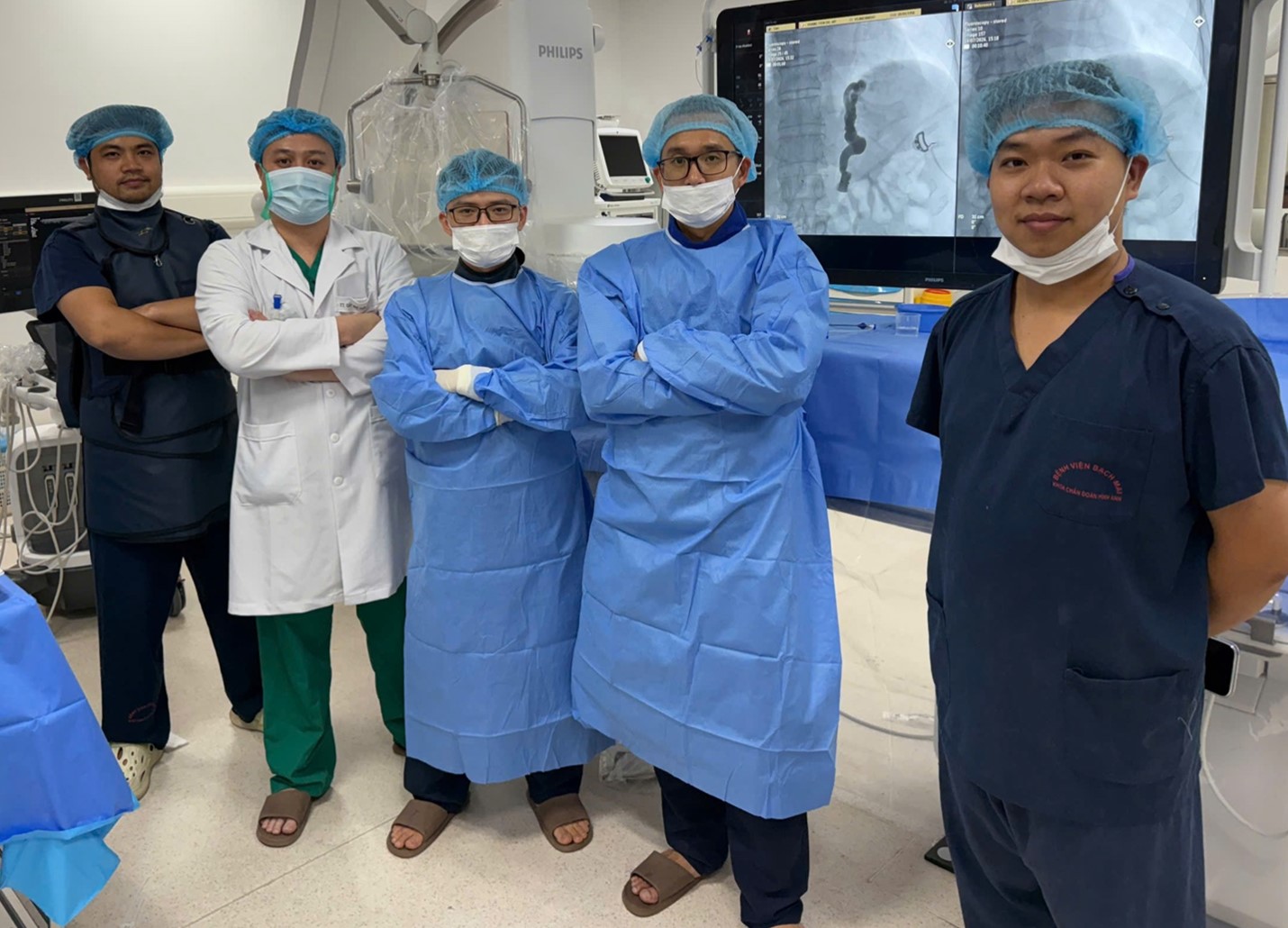
The interventional team consisting of M.D., Resident Doctor Do Dang Tan, M.D., Resident Doctor Nguyen Anh Tuan, Technician Vu Van Trieu and Dang Quang Anh from the Department of Radiology, and Doctor Tran Duc Minh from the Department of Anesthesiology and Resuscitation successfully performed the PARTO technique for the patient.
The successful deployment of the PARTO technique at the Bach Mai Hospital Ninh Binh facility is not only the result of close coordination among interventional radiologists, nurses, and supporting units, but also marks a new development milestone for the field of interventional radiology at the hospital.
More importantly, this technique opens up additional treatment opportunities for cirrhotic patients with gastrointestinal bleeding complications right locally, contributing to enhancing the capability of managing severe and complex cases at the Bach Mai Hospital Ninh Binh facility.
Building upon this initial success, the hospital will continue to develop advanced interventional radiology techniques, strengthen multi-specialty coordination, and aim to provide high-quality, safe, and more convenient medical services for the people of Ninh Binh and neighboring provinces.
M.D., Resident Doctor Do Dang Tan - Nguyen Ha



78 Giai Phong Street, Kim Lien Ward, Hanoi City
1900.888.866
096.985.1616
Department of Examination on Demand:
Department of Examination: Monday - Friday
National Route 21B, Liem Tuyen Ward, Ninh Binh Province
1900.888.866
0969851616
Outpatient Department on Demand (On-demand Clinic)
+ Monday - Friday:
+ Saturday - Sunday:
Outpatient Department (Standard Clinic): Monday - Friday
+ Working hours:
Main responsible person: Associate Professor, Dr. Dao Xuan Co - Hospital Director




