 Ngày đăng: 19/07/2026
Many middle-aged and elderly men often choose to endure silently when experiencing symptoms such as nocturia, dysuria, or hesitant urination. Partly because they think it is an ailment of old age, and partly because of the fear of surgery in a "sensitive area" with consequences such as urinary incontinence or a decline in masculine vitality. However, practical clinical data and new technologies shared by Dr. Nguyen Minh Tuan – Head of the Department of Urology (Bach Mai Hospital) at the international scientific seminar on July 18, 2026, are completely changing this perception.
Finding a solution to patients' biggest fear: Preserving physiological function
For urological surgery, the challenge for physicians is not only removing the hyperplastic tumor to clear the urinary tract, but also how to completely preserve the quality of life and physiological function for patients after surgery. The latest recommendations from the American Urological Association (AUA) and the European Association of Urology (EAU) currently prioritize personalized thinking, meaning choosing the least invasive and most appropriate solution for each specific physical condition.
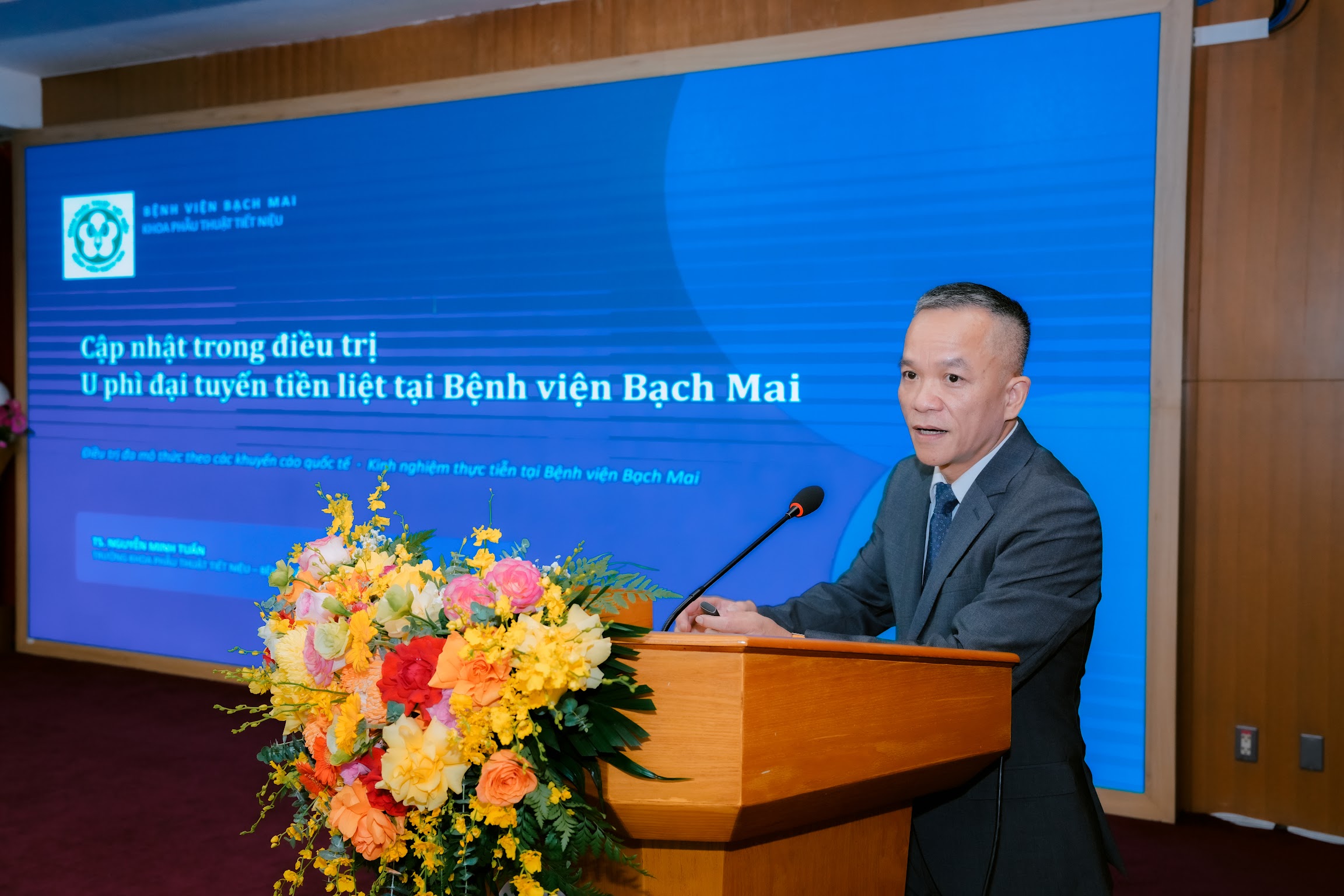
Assoc. Prof. Dr. Nguyen Minh Tuan shares about the trend of personalization in the treatment of benign prostatic hyperplasia
In practice at Bach Mai Hospital, a wide spectrum of techniques is being applied to realize this mindset. For patients who are most concerned about the complications of bladder neck fibrosis or deep tissue damage, Bipolar Plasma technology (Plasma Kinetic) with new-generation generator systems such as the ISG 410 is an answer. The long plasma column of this system helps doctors achieve excellent hemostasis at low temperatures, minimizing thermal spread damage. This technique is so safe that doctors only need to use spinal anesthesia, and the patient remains fully conscious throughout the surgery to communicate with the surgical team, helping to absolutely control perioperative cardiovascular risks.
However, speaking of the pinnacle of minimally invasive procedures, mention must be made of water vapor thermal therapy (REZUM) – a technique for which Bach Mai Hospital is one of the first units to receive technology transfer. Instead of using a cutting blade, pure water vapor is injected to naturally dissolve the hyperplastic tumor tissues. Because the internal urethral sphincter structure is completely untouched, complications such as erectile dysfunction or retrograde ejaculation are eliminated. Patients can even be discharged from the hospital after just one day of intervention.
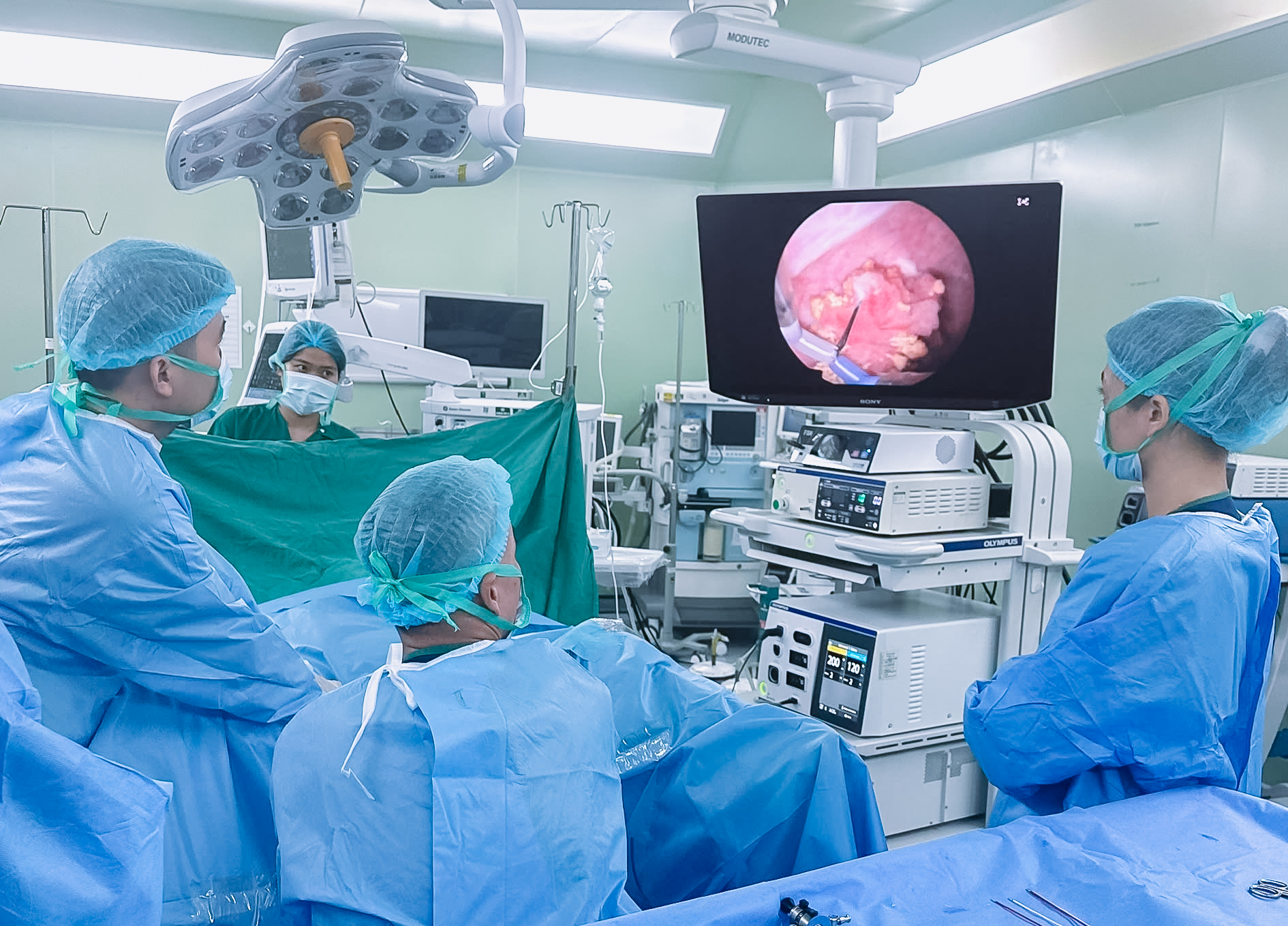
In addition, for tumors of excessive size, the solution of enucleation using high-power laser combined with a tissue morcellator to grind and aspirate the tumor tissue allows patients to resolve the condition completely without having to undergo an open incision. For cases that are too frail or have multiple underlying conditions and cannot tolerate surgery, the prostatic artery embolization solution performed in coordination with the Diagnostic Radiology Center causes the tumor to atrophy naturally.
Practical efficacy proven by telling figures
The strong shift toward minimally invasive technologies at Bach Mai Hospital is not merely theoretical, but is proven by clinical data itself when comparing the statistics of the first six months of this year with the same period last year:
Patient trust has increased markedly: The number of intervention cases rose from 68 to 98.
Rapid recovery, reduced costs: The average hospital stay for patients was shortened from 4.8 days to just 3.9 days.
Deeply improved quality of life: The postoperative International Prostate Symptom Score (IPSS) dropped sharply from 12.6 to 9.8 points. This means that after leaving the hospital, patients truly reclaim comfort in their daily activities. The recorded rate of good improvement at follow-up visits reached 92.2%.
Currently, the technical structure within the department is flexibly distributed to balance effectiveness and cost for the public: 66.7% of cases are maintained using monopolar electrocautery to optimize costs; 20% undergo prostate enucleation using bipolar electrosurgery and lasers; 13.3% have strongly transitioned to REZUM water vapor thermal therapy.
Dr. Nguyen Minh Tuấn advises that men entering middle age who experience signs of urinary disorders should go directly to reputable specialized facilities for examination and IPSS scoring. With the synchronization of equipment and wide technical spectrum available today, patients can completely rest assured in choosing a gentle, safe method that fully preserves their quality of life right in Viet Nam.
| EARLY BLADDER CANCER DETECTION TECHNOLOGY Not stopping at benign conditions, for non-muscle-invasive bladder cancer, the Department of Urology also applies narrow-band imaging (NBI) endoscopy technology. This system has the ability to clearly display the microvessels nourishing the tumor that conventional white light easily misses, helping doctors detect and completely resect cancer lesions at a very early stage, minimizing the risk of recurrence. |
Kim Long - The Anh



78 Giai Phong Street, Kim Lien Ward, Hanoi City
1900.888.866
096.985.1616
Department of Examination on Demand:
Department of Examination: Monday - Friday
National Route 21B, Liem Tuyen Ward, Ninh Binh Province
1900.888.866
0969851616
Outpatient Department on Demand (On-demand Clinic)
+ Monday - Friday:
+ Saturday - Sunday:
Outpatient Department (Standard Clinic): Monday - Friday
+ Working hours:
Main responsible person: Associate Professor, Dr. Dao Xuan Co - Hospital Director




