 Ngày đăng: 19/07/2026
Labor pain is always a concern for many pregnant women. With the development of modern medicine, epidural analgesia (EA) has become an effective pain relief method, routinely applied at Bach Mai Hospital in both its Ha Noi and Ninh Binh facilities. This technique is directly performed by doctors from the Center for Anesthesiology and Resuscitation, helping parturients reduce pain, conserve energy, and ensure safety throughout the delivery process.
An effective pain relief method during labor
Epidural analgesia is a technique of administering a low-concentration local anesthetic into the lumbar epidural space via a soft, thin catheter. The medication blocks the transmission of pain sensations from the uterus and birth canal, helping the parturient significantly reduce the sensation of pain while remaining fully conscious.
The anesthetic is continuously infused via an infusion pump with dosages precisely calculated by a doctor, maintaining pain relief efficacy until the baby is born.
Not only does it help the mother feel more comfortable, but this method also contributes to a smoother labor process, limits exhaustion, and creates favorable conditions for obstetric monitoring and management when necessary.
Procedure
Typically, epidural analgesia is performed when the cervix is dilated about 3 to 4 cm or at any time during labor if the parturient requests pain relief and has no contraindications.
Before the procedure, the parturient is instructed to sit or lie on her side with her back maximally curved to make it easier for the doctor to access the epidural space. After disinfection and local anesthesia, the doctor places the catheter in the correct position.
The catheter placement process usually causes only very mild discomfort. After a few minutes of medication infusion, the pain is significantly reduced, and the parturient remains conscious and able to cooperate with medical staff throughout delivery.
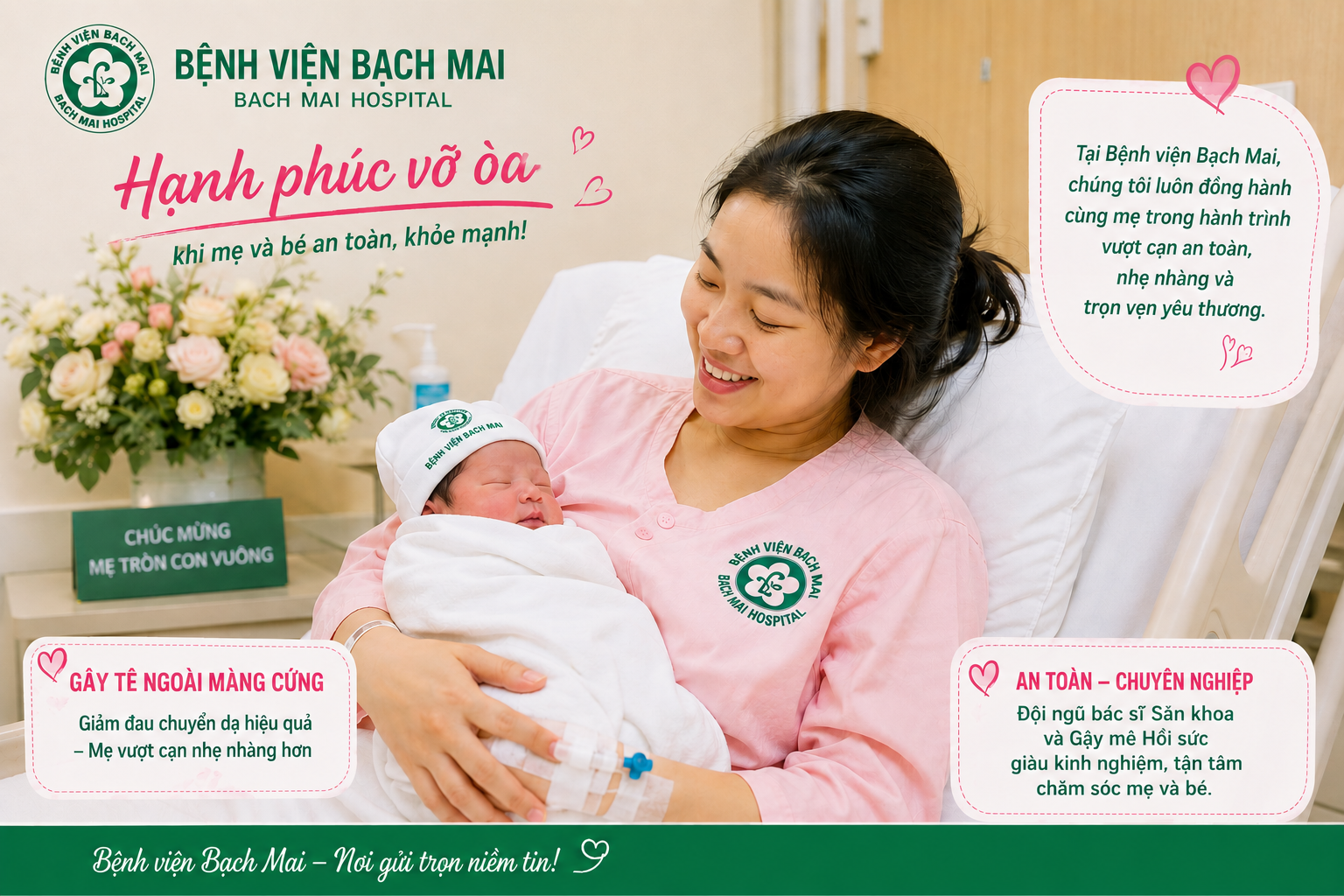
Note: Image generated by AI
Many benefits for mother and baby
According to doctors at the Center for Anesthesiology and Resuscitation, epidural analgesia brings many benefits:
Effectively reduces labor pain, helping parturients feel comfortable and conserve their strength.
Limits anxiety, stress, and fear during childbirth.
Creates favorable conditions for obstetricians to monitor, assist with delivery, and perform necessary procedures if required.
If a transition to emergency cesarean section is necessary, the already placed catheter can continue to be used to provide anesthesia for the surgery and postoperative pain relief.
Closely monitored to ensure safety
At Bach Mai Hospital, parturients receive pre-procedure fluid resuscitation and continuous monitoring of blood pressure, pulse, and fetal heart rate using modern monitoring systems to promptly detect and manage any changes that may occur, such as mild hypotension or nausea.
If there is significant numbness or heaviness in the legs, the doctor will adjust the medication dosage accordingly so that the parturient can still move comfortably.
Studies also show that epidural analgesia does not increase the rate of cesarean sections and is not the cause of chronic postpartum back pain.
Rare complications
Although evaluated as a safe method, epidural analgesia may still encounter some rare complications.
Post-dural puncture headache occurs in about 1% of cases due to inadvertent dural puncture. The majority resolve spontaneously after a few days or are treated with analgesics, fluid therapy, and rest. In cases of prolonged pain, doctors can perform the "Blood Patch" technique (autologous blood epidural patch) for management.
Serious adverse events such as local anesthetic systemic toxicity (LAST) and total spinal anesthesia are very rare. The Center for Anesthesiology and Resuscitation is always fully equipped with resuscitation facilities and specific treatment protocols, including the antidote Intralipid 20%.
Infection or epidural hematoma complications have an incidence of about 1 in 200,000 cases. The entire procedure is performed under strict aseptic conditions. When there are suspicious signs, the hospital has full diagnostic imaging facilities such as CT or MRI for prompt detection and management.
Cases where application is recommended and not recommended
Epidural analgesia is indicated for most parturients who request pain relief, have no contraindications, and have been examined by a doctor prior to delivery.
The method is particularly beneficial for pregnant women with cardiovascular disease, preeclampsia (when platelet count is above 100 G/L and there are no coagulation disorders), or respiratory diseases.
Conversely, this technique is not performed for parturients who refuse or are uncooperative; have severe coagulation disorders; have massive blood loss or shock; have an infection at the needle insertion site; are taking anticoagulants without a sufficient safe duration; or have certain complex neurological or spinal disorders.
In cases where the parturient is admitted when the cervix is already dilated significantly (above 6 to 8 cm) or labor progresses too rapidly, the doctor will consider more appropriate pain relief methods, such as low-dose spinal anesthesia.
| According to experts, epidural analgesia is currently an effective, safe, and widely applied method worldwide. Being fully counseled and choosing the appropriate pain relief method will help parturients have a smoother, safer, and more complete childbirth journey. |
Nguyen Toan Thang - Nguyen Van Hoang



78 Giai Phong Street, Kim Lien Ward, Hanoi City
1900.888.866
096.985.1616
Department of Examination on Demand:
Department of Examination: Monday - Friday
National Route 21B, Liem Tuyen Ward, Ninh Binh Province
1900.888.866
0969851616
Outpatient Department on Demand (On-demand Clinic)
+ Monday - Friday:
+ Saturday - Sunday:
Outpatient Department (Standard Clinic): Monday - Friday
+ Working hours:
Main responsible person: Associate Professor, Dr. Dao Xuan Co - Hospital Director




