 Ngày đăng: 15/01/2026Tác giả: Nguyen Ha
A recent case of meningococcal meningitis has been recorded at the Institute of Tropical Medicine, Bach Mai Hospital. Meningococcal meningitis is a dangerous infectious disease that progresses rapidly and can lead to severe complications, posing a life-threatening risk within a short time. Early detection, prompt isolation, and preventive measures are essential to control the spread of the disease.
According to doctors at the Bach Mai Institute of Tropical Medicine, the patient was transferred from a lower-level healthcare facility in a critical condition, presenting with deep coma, respiratory failure requiring mechanical ventilation, persistent high fever, gastrointestinal bleeding, and necrotic hemorrhagic rash.
Earlier, on January 8, the patient experienced fatigue and chills and self-administered intravenous fluids at home without improvement. By January 10, the fever worsened, accompanied by hemorrhagic rash in the neck and chest area and severe fatigue, though no headache was reported. The patient was then brought to the hospital by family members. Medical history revealed chronic hepatitis B under treatment, gastric ulcer and polyps, and recently diagnosed gout.
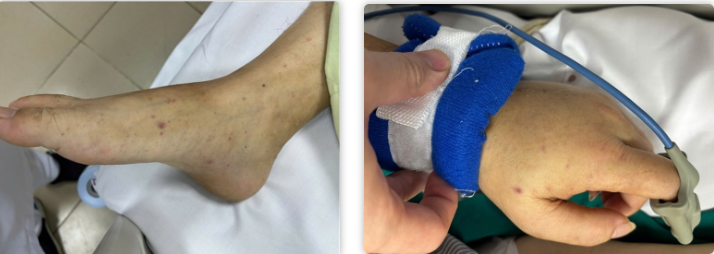
Hemorrhagic rash on the patient’s body
Suspecting meningococcal infection, doctors at the Institute of Tropical Medicine quickly isolated the patient and conducted a series of diagnostic tests, including blood tests, throat swabs, and cerebrospinal fluid analysis. Targeted antibiotics against the bacteria were administered immediately.
Laboratory results showed characteristic bacterial morphology under microscopy, and PCR testing confirmed infection with Neisseria meningitidis, the meningococcal bacterium. Close contacts, including family members and healthcare workers, were promptly notified and received prophylactic medication. The Institute also reported the case to relevant authorities in accordance with Circular No. 54/2015/TT-BYT issued on December 28, 2015.
The patient was diagnosed with meningococcal meningitis, with suspected septicemia, gastrointestinal bleeding due to esophageal ulcer, thrombocytopenia, and chronic hepatitis B.
The patient was placed on mechanical ventilation and received intensive treatment at the Institute of Tropical Medicine with close multidisciplinary collaboration from departments including Microbiology, Hematology and Blood Transfusion, Neurology, Diagnostic Imaging, Gastroenterology, and Nutrition at Bach Mai Hospital.
As of the morning of January 15, 2026, the patient’s condition had significantly improved. The patient was conscious and no longer required mechanical ventilation.
Speaking further about meningococcal meningitis, Assoc. Prof. Dr. Do Duy Cuong, Director of the Institute of Tropical Medicine at Bach Mai Hospital, explained that the disease is caused by the epidemic-prone bacterium Neisseria meningitidis, commonly residing in the throat and nasopharynx and transmitted through respiratory droplets.
The disease often occurs in crowded environments such as military barracks, dormitories, collective housing areas, and schools.
Those most affected are young people who have not developed immunity or received vaccination. The proportion of asymptomatic carriers ranges from 5–20%, with the highest prevalence among adolescents (23.7%).
These carriers represent a silent but dangerous reservoir, capable of spreading the disease if preventive measures are not taken. Risk factors include smoking, kissing, gathering in crowded places, and visiting bars or pubs. Many carriers are unaware that they harbor bacteria capable of causing severe or even fatal infections in others.
Meningococcal disease can progress extremely rapidly, causing meningitis and septicemia. In severe cases, it may lead to multiple organ failure and death within 24 hours if not treated promptly.
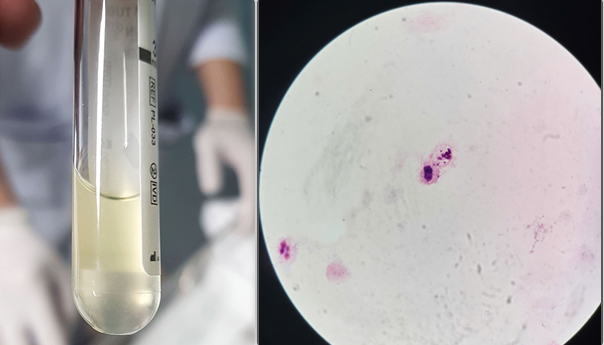
Turbid cerebrospinal fluid from the patient with microscopy showing coffee-bean–shaped Gram-negative diplococci, characteristic of Neisseria meningitidis
Even in survivors, serious long-term complications may occur, including hearing loss, seizures, or permanent neurological damage.
Meningococcal bacteria include several serogroups, of which B, A, C, Y, and W are the most common causes of disease in Vietnam and worldwide.
Vaccination remains the most effective preventive measure. Currently, two important vaccines are available:
Bexsero (GSK – Italy): protects against serogroup B
Menactra (Sanofi – USA): protects against serogroups A, C, Y, and W-135
“People, especially children and adolescents, should receive the full vaccination schedule and combine both vaccines as recommended to ensure comprehensive protection against circulating meningococcal strains,” Dr. Cuong emphasized.
He also advised that individuals experiencing suspected symptoms such as fever, fatigue, confusion, slow response, or hemorrhagic rash under the skin should seek immediate medical attention for timely diagnosis and treatment.
At the same time, healthcare authorities should promptly identify and manage outbreak areas, monitor close contacts, and implement preventive measures to prevent further spread of the disease.



78 Giai Phong Street, Kim Lien Ward, Hanoi City
1900.888.866
096.985.1616
Department of Examination on Demand:
Department of Examination: Monday - Friday
National Route 21B, Liem Tuyen Ward, Ninh Binh Province
1900.888.866
0969851616
Outpatient Department on Demand (On-demand Clinic)
+ Monday - Friday:
+ Saturday - Sunday:
Outpatient Department (Standard Clinic): Monday - Friday
+ Working hours:
Main responsible person: Associate Professor, Dr. Dao Xuan Co - Hospital Director




