 Ngày đăng: 13/07/2026
Doctors at Bach Mai Hospital, Ninh Binh facility, have successfully performed the first Endoscopic Retrograde Cholangiopancreatography (ERCP) to treat choledocholithiasis for an 80-year-old patient suffering from cholangitis. The success of this intervention marks a significant milestone in the implementation of advanced techniques at the Ninh Binh facility, affirming the readiness of the expert team and modern equipment system in patient care.
The patient is Mrs. N.T.S. (80 years old, residing in Le Ho commune), who was admitted with epigastric pain, high fever, and jaundice. Ten years prior, she had undergone surgery and chemotherapy for breast cancer and has a long-standing history of hypertension. Her advanced age combined with multiple underlying medical conditions required a treatment method that ensures both efficacy and safety.
Magnetic resonance imaging (MRI) of the abdomen revealed dilation of the intrahepatic and extrahepatic bile ducts, with the common bile duct dilated to 16 mm, containing multiple stones approximately 8 mm in size causing obstruction of bile flow, along with accumulated biliary sludge. Large stones were also noted in the gallbladder.
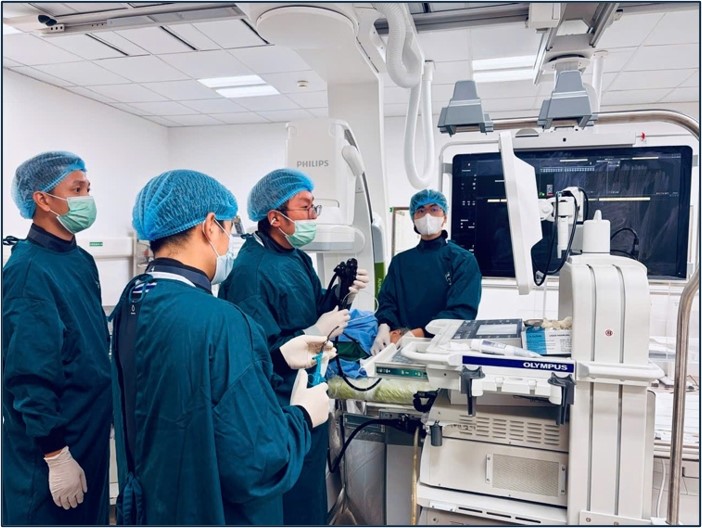
A professional pancreatobiliary intervention team and modern equipment helped the 80-year-old patient avoid open surgery.
After consultation at the Center’s briefing session chaired by Assoc. Prof. Nguyen Cong Long, the doctors reached a consensus to indicate emergency Endoscopic Retrograde Cholangiopancreatography (ERCP). The procedure was directly performed by MSc. MD. Dang Trung Hieu, a specialist in pancreatobiliary intervention at Bach Mai Hospital.
According to MSc. MD. Dang Trung Hieu, instead of open surgery which carries many risks for elderly patients, the team opted for the ERCP technique to remove stones via natural orifices.
"This is the first patient to undergo the ERCP technique at Bach Mai Hospital, Ninh Binh facility. This method facilitates stone removal and biliary drainage without the need for open surgery, reducing pain, limiting complications, and shortening recovery time," said Dr. Hieu.
On the afternoon of July 7, 2026, the intervention was carried out. Via gastro-duodenoscopy, the team used a specialized endoscope to access the bile duct, introduced stone extraction tools, and released the infected bile flow. The entire procedure was performed through natural orifices, leaving no skin incisions like traditional surgery.
Following the intervention, the patient was monitored at the Digestive and Hepatobiliary Center. After just one day, the patient's health improved significantly; she was pain-free and able to resume eating. Blood tests also showed a significant reduction in infection and biliary obstruction, indicating a good response to treatment.
The success of the first ERCP case continues to affirm the professional capacity of the medical team and the modern equipment system deployed synchronously between the two facilities of Bach Mai Hospital. Thereby, residents in the Ninh Binh area and neighboring provinces have more opportunities to access advanced techniques right in their locality, reducing waiting times and saving travel costs while still benefiting from high-quality medical services according to the standards of Bach Mai Hospital.



78 Giai Phong Street, Kim Lien Ward, Hanoi City
1900.888.866
096.985.1616
Department of Examination on Demand:
Department of Examination: Monday - Friday
National Route 21B, Liem Tuyen Ward, Ninh Binh Province
1900.888.866
0969851616
Outpatient Department on Demand (On-demand Clinic)
+ Monday - Friday:
+ Saturday - Sunday:
Outpatient Department (Standard Clinic): Monday - Friday
+ Working hours:
Main responsible person: Associate Professor, Dr. Dao Xuan Co - Hospital Director




