 Ngày đăng: 26/03/2026Tác giả: Kim Long - Thanh Duong
In the solemn and proud atmosphere of March, Bach Mai Hospital hosted the International Scientific Conference on Non-Communicable Disease Prevention and the 45th Anniversary of the Respiratory Center. The event was not only a large-scale scientific forum but also a milestone marking the hospital’s strong transformation as a special-class institution in the era of modern medicine.
The conference was attended and directed by Ms. Nguyen Thi Lien Huong, Vice Minister of Health, along with distinguished international guests: H.E. Olivier Brochet, Ambassador of France to Vietnam; Mr. Gilles Angles, Health and Social Development Cooperation Attaché; Mr. Saito Masafumi, First Secretary of the Embassy of Japan in Vietnam; and Mr. Matsubara Yoshikazu, Health Policy Advisor at the Ministry of Health under the Japan International Cooperation Agency (JICA) in Vietnam.
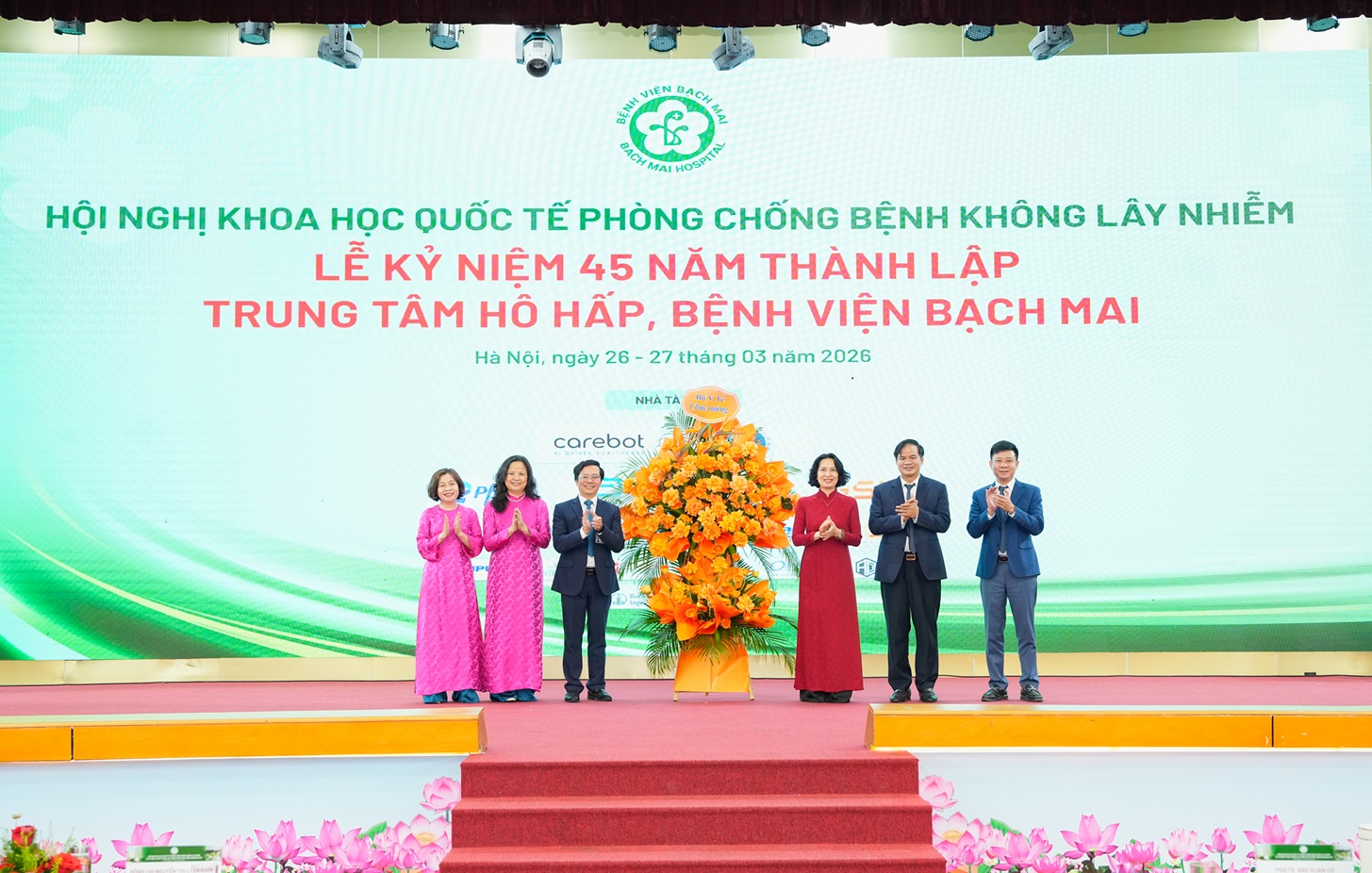
Leaders from provinces including Nghe An, Lang Son, Lao Cai, Thai Nguyen, Cao Bang, and Quang Ninh were also present. The strong engagement of governmental authorities and international organizations underscores the strategic importance of the conference, as non-communicable diseases (NCDs) are increasingly becoming a major burden on public health and national sustainable development.
“The Bach Mai Identity” – Professional Excellence and Dedication
In his opening remarks, Assoc. Prof. Dr. Dao Xuan Co, Party Secretary and Director of Bach Mai Hospital, reflected on more than a century of development. He emphasized:
“Bach Mai Hospital is not merely a large healthcare facility; it has become a symbol of modern Vietnamese medicine-a convergence of intellect, resilience, and dedication. Over more than a century, we have cultivated the Bach Mai identity: strong professional competence, exemplary medical ethics, and unwavering resilience in the face of challenges. Our standing is measured not only by technical capacity or reputation, but by our ability to undertake the most demanding missions and deliver tangible contributions to public health.”
Throughout his speech, he reaffirmed Bach Mai’s role as a leading institution. In the context of population aging and the rising prevalence of chronic diseases, the hospital not only provides treatment but also leads in professional guidance, high-quality workforce training, and serves as a core pillar in safeguarding national health security.
The conference addressed a critical challenge in modern medicine: the growing burden of NCDs, including cancer, cardiovascular diseases, stroke, and chronic respiratory diseases. According to Assoc. Prof. Dr. Dao Xuan Co, this is no longer an issue for individual specialties but a system-wide challenge.
To realize its vision, Bach Mai Hospital is committed to shifting from a reactive model of “treating disease” to proactive health management, early detection, and personalized care. This approach is being implemented through digital transformation, the application of artificial intelligence (AI), and modern hospital governance systems introduced at the conference.

Strategic Direction from the Ministry of Health: A Shift Toward Prevention
On behalf of the Ministry of Health, Vice Minister Nguyen Thi Lien Huong acknowledged and highly appreciated the contributions of Bach Mai Hospital. She highlighted that NCDs account for more than 70% of global deaths, requiring urgent long-term strategies.
She directed: “Bach Mai Hospital should continue to play a central role in leading the healthcare system in updating internationally standardized treatment protocols; strengthening training and technology transfer to lower-level facilities; and accelerating digital transformation. These are essential actions to shift from a treatment-focused model to proactive prevention and comprehensive healthcare.”
45-Year Legacy and the Establishment of the Bach Mai Institute of Respiratory Medicine
A key highlight of the event was the 45th anniversary of the Respiratory Center. From a small clinical department established in 1981, it has now developed into a major specialized institute-officially announced as the Bach Mai Institute of Respiratory Medicine.
Assoc. Prof. Dr. Dao Xuan Co affirmed that the Institute exemplifies the hospital’s academic depth. With advanced techniques such as rigid bronchoscopy, tracheobronchial stenting, and multi-layer laser interventions, the Institute has saved thousands of lives and serves as a reputable center for training and international collaboration.
“The greatest reward is the continuation of breath-the hope restored to patients and their families,” he shared.

Breakthroughs in Digital Ecosystems and Smart Infrastructure
During the conference, Bach Mai Hospital introduced a series of innovative digital transformation solutions, marking significant progress toward building a smart hospital:
A multilingual website ecosystem and the “Bach Mai Care” application, supporting both domestic and international patients and overcoming language barriers.
AI-powered camera surveillance systems integrated with the Hanoi Police Department, enhancing security and clinical management quality.
A centralized Smart ICU management system and the “Bach Mai Staff” application, optimizing monitoring and treatment of critically ill patients.
A multilingual international insurance guarantee portal, improving services for foreign patients.
A cashless, contactless traffic fee collection system, reducing waiting time and improving patient experience.
Expanding Impact - Partnerships for Community Health
Guided by the philosophy “Bach Mai grows to share,” the hospital has established comprehensive partnerships with multiple strategic partners:
Collaboration with six provinces-Nghe An, Lao Cai, Quang Ninh, Cao Bang, Thai Nguyen, and Lang Son-on technology transfer, training, and health data integration.
Partnerships with leading national institutions, including the National Institute of Forensic Medicine, the National Lung Hospital, and the National Coordinating Center for Organ Transplantation.
International and technological collaborations with Viettel, the Health Data Research Association, the Taiwan Artificial Intelligence Development Association, and Abbott Laboratories GmbH.
These partnerships not only expand access to high-quality healthcare for underserved populations but also accelerate the application of advanced AI technologies in clinical practice in Vietnam.

A High-Level Scientific Forum and the “Green Living” Message
Following the opening ceremony, the conference featured four plenary sessions and multiple specialized sessions, bringing together more than 1,000 delegates and scientists from Vietnam and abroad. Presentations on COPD, asthma, cancer, and age-related chronic diseases created a dynamic and high-quality academic forum.
Notably, the organizing committee encouraged replacing congratulatory flower stands with green plants, promoting a message of sustainability and environmental responsibility within the healthcare sector.
The success of the conference and the 45th anniversary celebration marks a new phase of development for the Institute of Respiratory Medicine and Bach Mai Hospital as a whole. With a 115-year legacy and a strong commitment to innovation, Bach Mai Hospital continues to affirm its leadership role, expand its international standing, and make meaningful contributions to the protection and promotion of public health.




78 Giai Phong Street, Kim Lien Ward, Hanoi City
1900.888.866
096.985.1616
Department of On-Demand Medical Examination:
Outpatient Department: Monday – Friday
Main responsible person: Associate Professor, Dr. Dao Xuan Co - Hospital Director




