 Ngày đăng: 26/04/2026Tác giả: Nguyen Ha
Continuous renal replacement therapy (CRRT) is no longer limited to kidney function replacement but is increasingly recognized as a multi-organ support tool, enabling early intervention and optimizing treatment in critically ill patients. This was the key message highlighted by both domestic and international experts at the recent scientific training program titled “Updates on New Trends in Continuous Renal Replacement Therapy (CRRT) and Treatment Optimization Strategies” held at Bệnh viện Bạch Mai.
Beyond being an academic forum for knowledge exchange and clinical experience sharing, the program also introduced advanced technological solutions in CRRT, particularly the OMNI system and optimized anticoagulation strategies for critically ill patients.
From “Renal Replacement” to Comprehensive Critical Care Strategy
According to experts, with advancements in modern technology, CRRT systems today not only address renal dysfunction but also contribute to fluid management, acid-base balance, toxin removal, and support for cardiovascular, respiratory, hepatic, and neurological functions in complex clinical scenarios.

This marks a significant shift in intensive care medicine, where treatment is no longer organ-specific but aims for comprehensive systemic protection.
At the conference, experts also updated the current status of CRRT implementation in Vietnam, particularly in the context of a growing number of critically ill patients with acute kidney injury, septic shock, and multi-organ failure.
Dr. Khuong Quoc Dai (MD, Resident), from the Emergency Center A9, noted that CRRT is playing an increasingly important role in managing critically ill patients. However, selecting appropriate anticoagulation strategies that ensure both treatment efficacy and patient safety remains a major challenge in daily clinical practice.
Advances in Anticoagulation and Extracorporeal Support
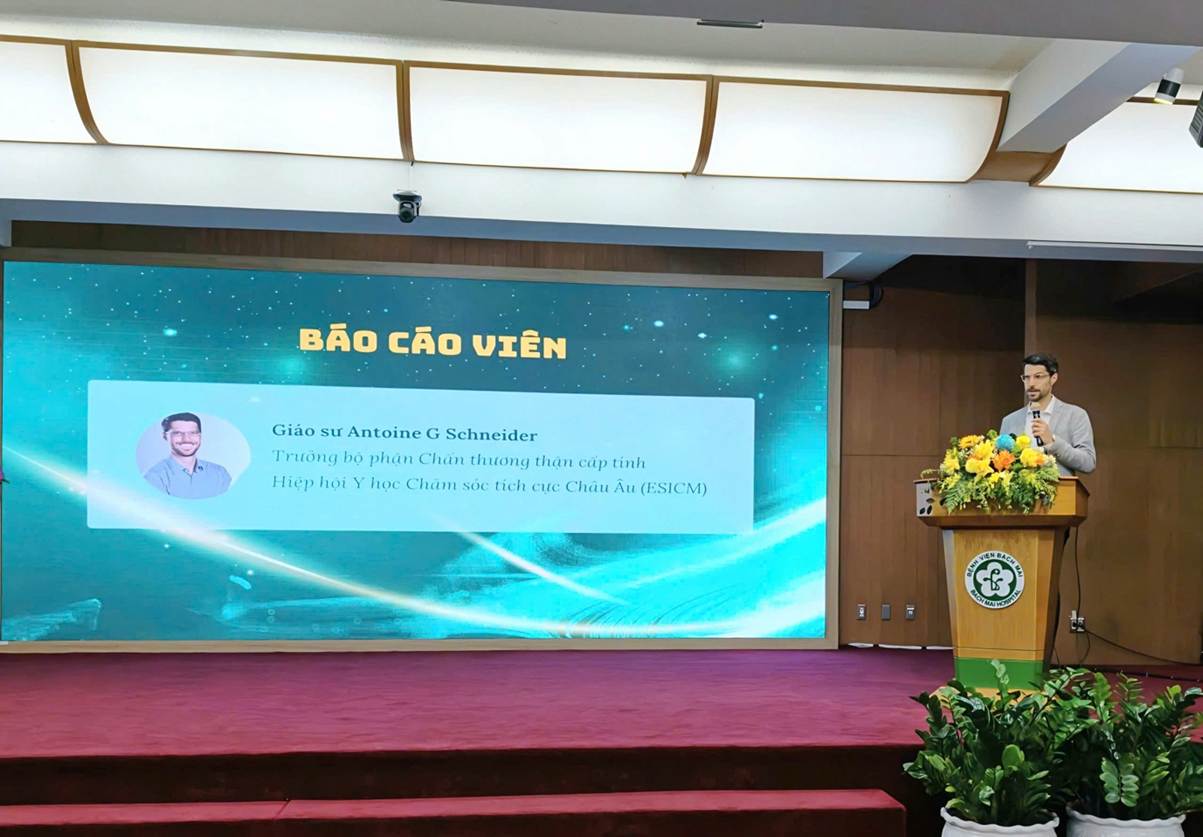
One of the program’s key highlights was the presentation by Professor Antoine G. Schneider on the role of regional citrate anticoagulation (RCA) in CRRT using the OMNI system. According to him, RCA helps prolong filter lifespan, reduce bleeding risks, and enhance treatment efficiency, particularly in complex critical care cases.
This was followed by insights from Dr. Pham Minh Huy of Cho Ray Hospital, who presented updates on extracorporeal carbon dioxide removal (ECCO₂R) in patients undergoing CRRT. Experts discussed influencing factors, clinical indications, and the potential of integrating ECCO₂R with CRRT on the OMNI platform, along with real-world clinical cases and the importance of individualized treatment approaches.
In addition to theoretical sessions, participants—including physicians and healthcare professionals—engaged in hands-on practice with the OMNI system, managing common clinical scenarios and optimizing treatment settings.
CRRT – A Pillar of Modern Critical Care
Speaking on the sidelines of the conference, Associate Professor Do Ngoc Son, Director of the Intensive Care Center at Bệnh viện Bạch Mai, emphasized a significant shift in clinical approach.
“In the past, CRRT was often considered only when patients developed severe kidney failure. Today, the trend is toward earlier, more proactive, and individualized intervention. Waiting until kidney function is critically impaired may mean missing the golden window for treatment,” he said.
He explained that an injured kidney is like a weakened organ under strain. Without timely support, continued overload may lead to irreversible damage, chronic kidney disease, or even lifelong dialysis.
“CRRT can be seen as a temporary replacement that allows the kidneys to rest and recover. As function improves, we gradually reduce support and discontinue treatment at the appropriate time,” he added.
He also warned that many patients survive the acute critical phase but later suffer from chronic kidney complications due to suboptimal early management of acute kidney injury. Therefore, early detection and proactive intervention are becoming essential trends in modern treatment.
According to data from the Intensive Care Center, approximately 30–50% of critically ill patients require some form of blood purification therapy, including CRRT. In modern intensive care, CRRT has become one of the core treatment pillars.
“An ICU without blood purification systems can hardly be considered fully equipped. Many patients would lose their chance of survival without this modality. In critical care, time is life. Early detection and timely intervention are decisive factors in reducing multi-organ complications and preserving survival opportunities for patients who might otherwise have no hope. Above all, training and technology transfer to lower-level healthcare facilities remain both the responsibility and mission of Bạch Mai Hospital,” Associate Professor Son emphasized.



78 Giai Phong Street, Kim Lien Ward, Hanoi City
1900.888.866
096.985.1616
Department of On-Demand Medical Examination:
Outpatient Department: Monday – Friday
Main responsible person: Associate Professor, Dr. Dao Xuan Co - Hospital Director




