 Ngày đăng: 02/03/2026
On the morning of March 1, 2026, at a resort in Soc Son, Hanoi, a 3-year-old child accidentally fell into a swimming pool. When discovered, the child was in respiratory and cardiac arrest. In this critical moment, the prompt intervention of a female doctor from Bach Mai Hospital became a decisive, life-saving turning point. Immediate cardiopulmonary resuscitation (CPR) was performed, and within just one to two minutes, the child’s circulation was successfully restored.
The story of Dr. Quynh Huong, from the Department of Gastroenterology and Hepatology, is more than an act of courage in an emergency. It also serves as a vivid demonstration of the effectiveness of Bach Mai Hospital’s systematic training strategy in cardiopulmonary resuscitation and circulatory arrest management.
Two Decisive Minutes by the Pool
During a weekend retreat in Soc Son, Dr. Quynh Huong came upon a young child who had just been pulled from the swimming pool, cyanotic and unresponsive. Without a moment’s hesitation, she immediately rushed to provide emergency assistance.
Recalling the incident, Dr. Huong said: “My first instinct was to provide emergency care immediately. My only thought was to act as quickly as possible to save the child.”
Recognizing that the child was not breathing and showed no response, she promptly initiated cardiopulmonary resuscitation (CPR) in accordance with the C-A-B protocol: chest compressions, airway management, and rescue breathing, using techniques appropriate for a young child. After approximately one to two minutes, the child began to show signs of recovery.
In a life-threatening emergency such as this, there is no time for hesitation or for recalling theory step by step. Clinical skill must become instinctive action.

From Training to Professional Instinct
The ability of medical staff to respond effectively to emergencies in everyday life, even outside the hospital setting, is not a matter of chance. Behind this readiness lies the strategic vision of Assoc. Prof. Dr. Dao Xuan Co, Director of Bach Mai Hospital.
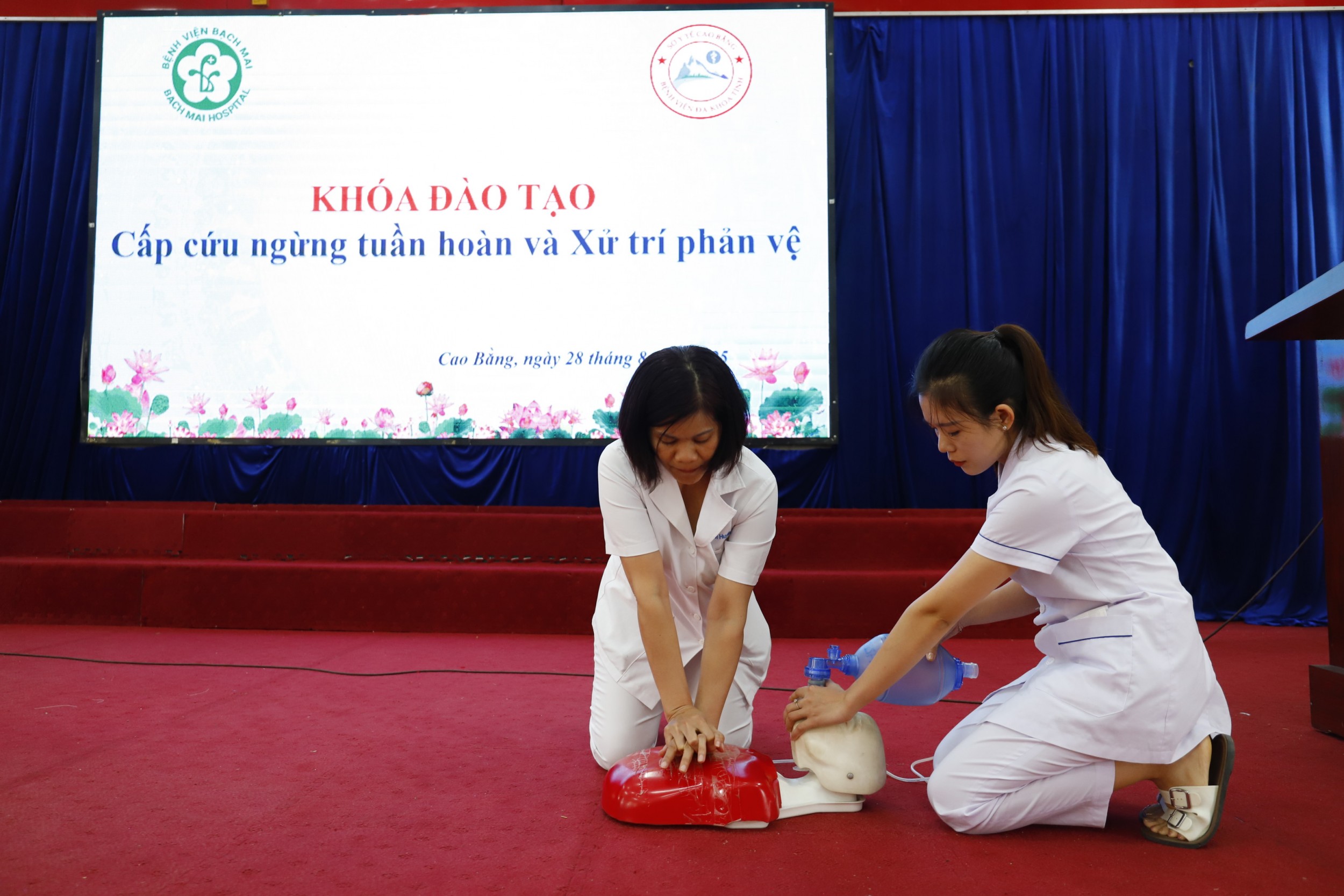
Under his leadership, emergency resuscitation training has been identified as a core professional competency, extending beyond intensive care and emergency medicine specialists alone. Guided by the philosophy that “emergency care is a vital life skill,” Bach Mai Hospital launched a large-scale cardiopulmonary resuscitation and circulatory arrest management training program for its entire medical workforce.
From May to September 2025, all 4,454 staff members of the Hospital participated in training through 30 consecutive classes. Each course was structured into six sessions, including two theoretical sessions and four practical sessions.
To complete the program, participants were required to pass both an online theoretical examination and a hands-on practical assessment using a mannequin. Certification was granted only to those who successfully met all five mandatory competency criteria: correct hand positioning, appropriate compression depth, full chest recoil, proper compression rate, and correct bag-mask ventilation technique.
Bringing Life-Saving Skills into the Community
Recent emergency rescues—from the incident in Soc Son to the supermarket case on February 25—are more than individual acts of courage. They demonstrate Bach Mai Hospital’s clear commitment to turning emergency response skills into instinctive professional action.
Yet the Hospital’s vision goes further. According to its leadership, expanding CPR training not only for healthcare workers but also, in the future, for the broader community will help build a wider frontline of emergency support. As first-aid skills become more widely shared, the likelihood of survival during the “golden minutes” of emergency care will increase significantly.
By Dieu Hien



78 Giai Phong Street, Kim Lien Ward, Hanoi City
1900.888.866
096.985.1616
Department of On-Demand Medical Examination:
Outpatient Department: Monday – Friday
Main responsible person: Associate Professor, Dr. Dao Xuan Co - Hospital Director




